

PULSAR: Graph-Based Positive Unlabeled Learning with Multi-Stream Adaptive Convolutions for Parkinson’s Disease Recognition
- 1Bangladesh University of Engineering and Technology, Bangladesh
- 2University of Massachusetts Amherst, USA
- 3University of Rochester, USA
Abstract
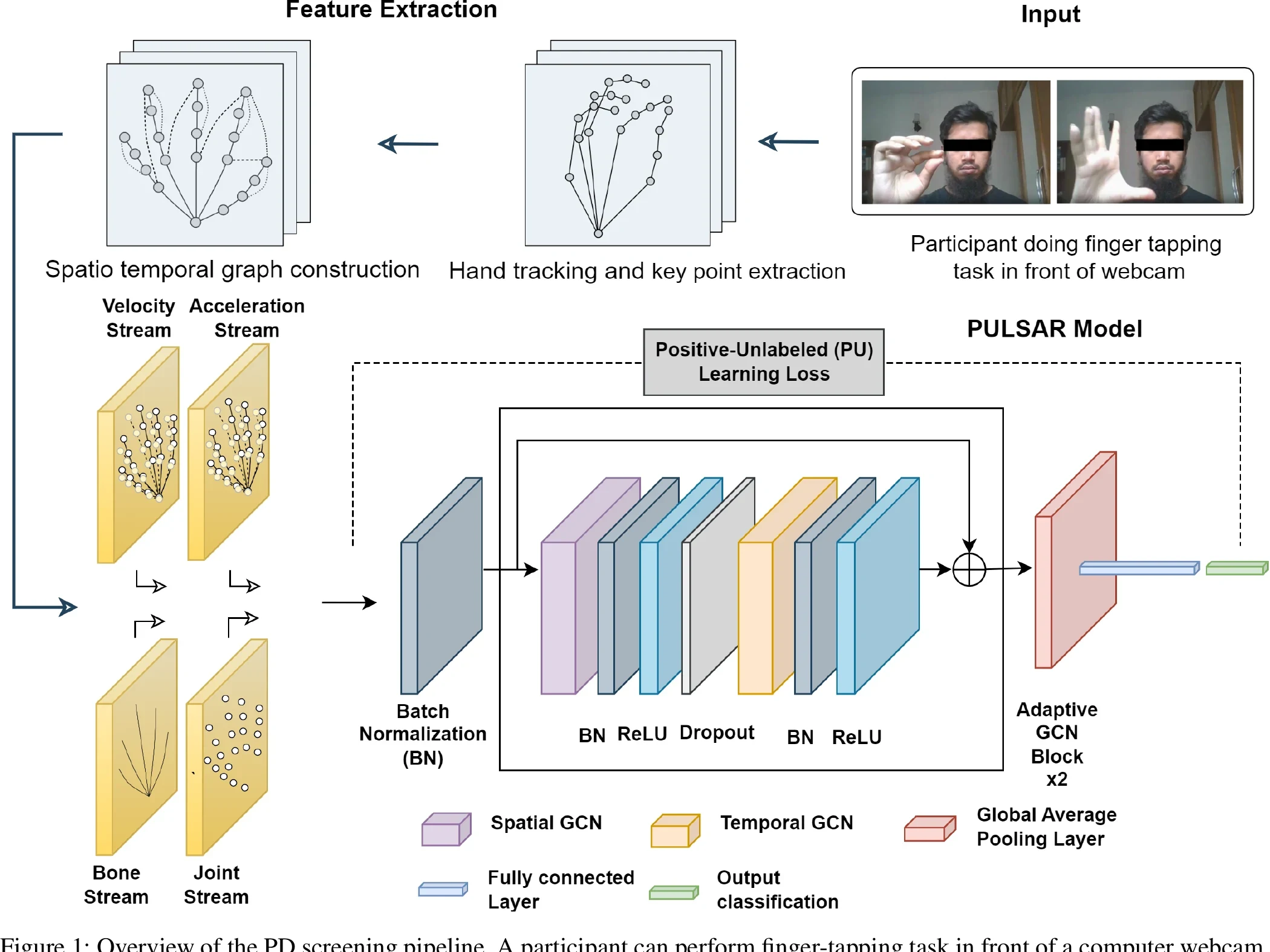
PULSAR is a method for screening Parkinson’s disease from webcam-recorded videos of the finger-tapping task used in the MDS-UPDRS. It is trained and evaluated on data from 382 participants, including 183 participants who self-reported Parkinson’s disease.
An adaptive graph convolutional network learns task-specific spatiotemporal relationships, while a multi-stream architecture captures finger-joint location, tapping velocity, and acceleration. Positive-unlabeled learning addresses potentially undiagnosed cases among self-reported negative labels and outperforms traditional supervised learning. PULSAR achieves 80.95% validation accuracy and 71.29% mean accuracy on an independent test set, demonstrating promise for accessible screening when reliable clinical labels are scarce.
Citation
Alam, M. Z. U., Azad, A., Islam, M. S., Hoque, E., & Rahman, M. S. (2026). PULSAR: Graph-Based Positive Unlabeled Learning with Multi-Stream Adaptive Convolutions for Parkinson’s Disease Recognition. ACM Transactions on Computing for Healthcare, 7(2). https://doi.org/10.1145/3799417