Validation of Remote Multimodal AI Screening for Parkinson Disease Across Diverse Settings
- 1University of Rochester, Rochester, NY, USA
- 2Bangladesh University of Engineering and Technology, Dhaka, Bangladesh
- 3Atria Health and Research Institute, New York, NY, USA
- 4University of Rochester Medical Center, Rochester, NY, USA
- 5InMotion, Beachwood, OH, USA
- 6Harvard Medical School, Boston, MA, USA
- 7Google Research, London, UK
- 8Ministry of Defense, Riyadh, Saudi Arabia
Abstract
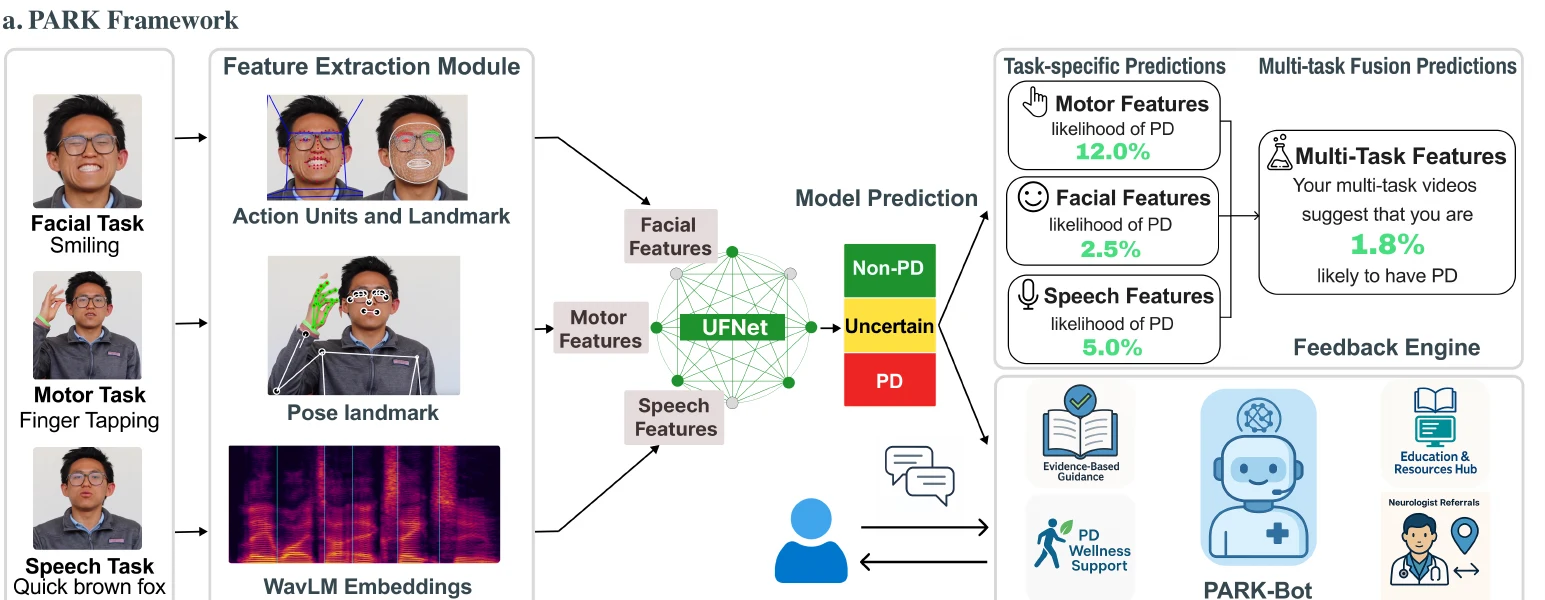
Timely detection of Parkinson’s disease remains limited by reliance on costly and geographically inaccessible in-person neurological evaluations. PARK is a web-based AI tool that screens for Parkinson’s disease using short webcam recordings of facial-expression, motor, and speech tasks.
Across eight independent studies involving 1,865 participants, task-specific neural networks estimate risk and uncertainty before an uncertainty-calibrated fusion model combines their predictions. PARK achieves 80.2–80.6% accuracy and 0.85–0.87 AUROC across internal and external cohorts, remains stable across demographic groups, and receives favorable usability ratings in supervised and unsupervised settings. The findings support accessible, equitable, and uncertainty-aware remote neurological screening.
Citation
Islam, M. S., Adnan, T., Abdelkader, A., et al. (2026). Validation of remote multimodal AI screening for Parkinson disease across diverse settings. Communications Medicine.